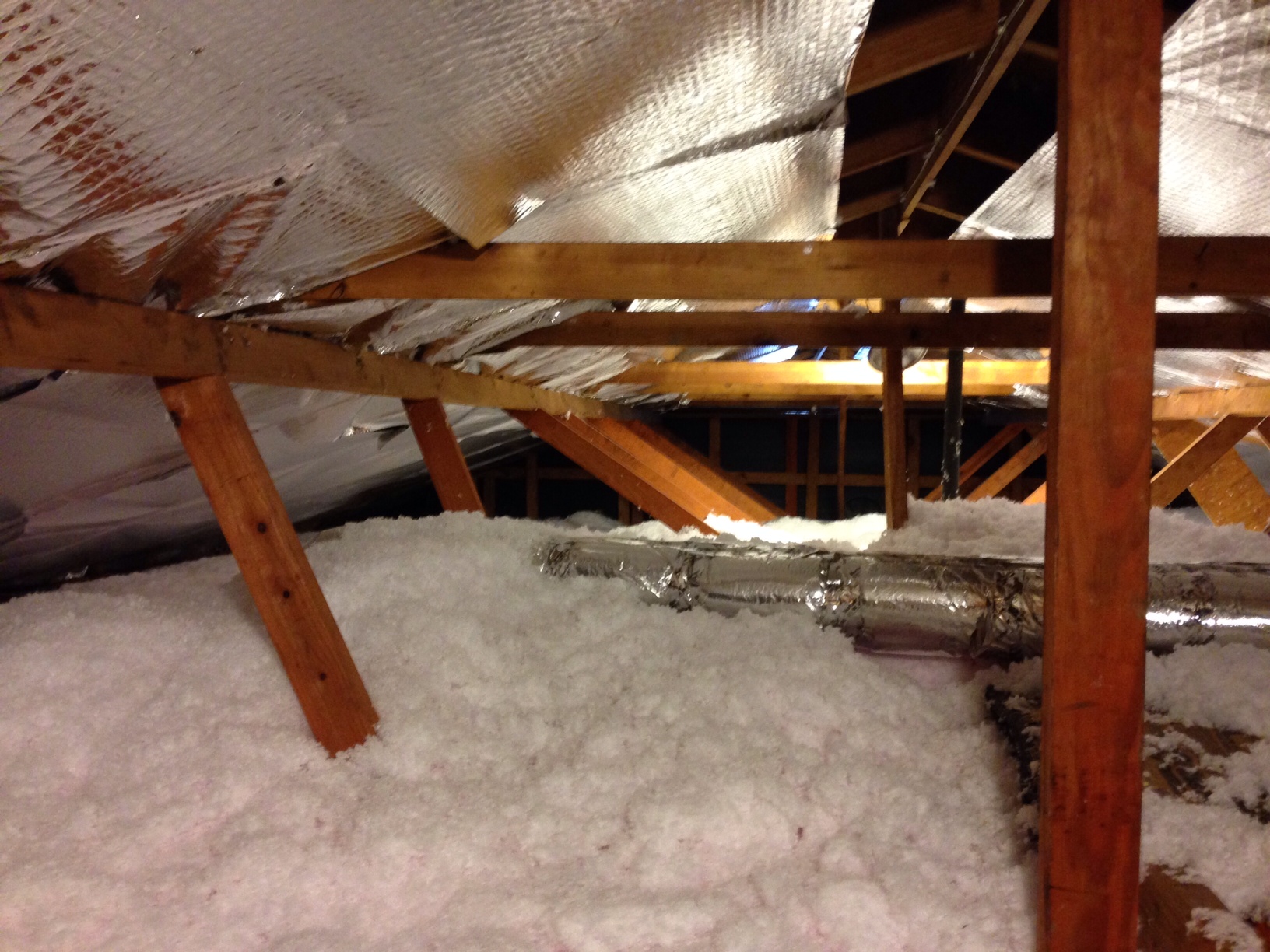
Most attic insulation quotes land somewhere between $1,500 and $6,000. The spread comes down to two questions: what material you’re installing, and whether a crew has to remove what’s already up there first. This guide breaks out cost by material, what moves the price beyond the per-square-foot number, and where a homeowner can reasonably do part of the job without hiring it out. It also breaks out cost by R-value, because square footage alone doesn’t say what you’re buying. R-49, the depth most cold-climate codes recommend, takes close to twice the material of R-30, whichever type you choose.
Cost by Material
Blown-in cellulose and blown-in fiberglass are the cheapest way to hit a good R-value across an open attic floor, which is why they’re the default recommendation for most homes. Fiberglass batts cost about the same per square foot but take longer to install correctly around obstructions, wiring, and irregular joist spacing.
Spray foam sits well above both.
It’s the only option that air-seals as it insulates, which matters for older homes with a leaky attic floor, but it roughly doubles or triples the price of blown-in material. R-value per inch is what turns these material choices into a number of inches, and inches are what a contractor is pricing when they quote a total. Add that column to the cost table, and the question this guide is named for finally has an answer: what R-49 costs changes depending on which material you pick.
| Material | R-Value per Inch | Depth for R-49 | Cost per sq ft (installed) | Typical Total, 1,000 sq ft Attic |
|---|---|---|---|---|
| Blown-in cellulose | R-3.2 – R-3.8 | 13 – 15 in. | $0.90–$3.00 | $900–$3,000 |
| Blown-in fiberglass | R-2.2 – R-2.7 | 18 – 22 in. | $1.00–$3.00 | $1,000–$3,000 |
| Fiberglass batts | R-3.0 – R-3.7 | 13 – 16 in. (layered) | $0.75–$2.60 | $1,500–$2,600 |
| Open-cell spray foam | R-3.5 – R-3.8 | 13 – 14 in. | $1.50–$2.00 | $2,200–$4,100 |
| Closed-cell spray foam | R-6.0 – R-7.0 | 7 – 8 in. | $4.00–$8.00 | $3,000–$6,000 |
Closed-cell spray foam is the outlier in that table.
Contractors typically spray it 3 to 5 inches thick for air-sealing and land at R-21 to R-30, not R-49. Going deeper multiplies an already expensive material fast. Most jobs that use it pair a few inches of closed-cell at the attic floor with blown-in cellulose on top, instead of filling the whole depth with foam.
What It Costs to Hit R-49 in a 1,000 Sq Ft Attic
R-49 is the Department of Energy’s recommendation for attic insulation in cold and mixed-cold climates, covering most of the northern half of the country plus high-elevation areas further south. That’s the gap in this title. Here’s the direct answer for the material most homes use to get there: blown-in cellulose.
| Target R-Value | Depth | Installed Cost |
|---|---|---|
| R-30 | 7.9 – 9.4 in. | $800–$2,000 |
| R-38 | 10 – 11.9 in. | $1,000–$2,500 |
| R-49 | 12.9 – 15.3 in. | $1,200–$3,000 |
| R-60 | 15.8 – 18.8 in. | $1,500–$3,500 |
Two things move that range. A first-time install into a bare attic floor costs more than a top-up over existing insulation, since a top-up needs less new material to close the same gap. And removal, if the existing insulation is wet or contaminated, is a separate line item (the $1.00–$2.25 per sq ft mentioned below) that this table doesn’t include.
Fiberglass costs more too. Blown-in fiberglass delivers less R-value per inch than cellulose, so hitting R-49 with fiberglass takes roughly 40% more material by volume than cellulose needs for the same target, a gap that comes straight out of the R-value-per-inch figures in the table above, not brand pricing.
What Pushes the Price Beyond the Base Rate
The per-square-foot numbers above assume a clear attic floor and standard access. In practice, four things routinely add to the bill.
- Removing old, damaged, or contaminated insulation before the new material goes in adds roughly $1.00–$2.25 per sq ft — often the single biggest line item beyond the material itself.
- Region matters more than most homeowners expect. The Northeast and West Coast run 10–20% above the national average on both labor and material; the Southeast and Midwest tend to land at or below it.
- Attic access and roof pitch change labor time directly — a walk-up attic with standard framing is quick to work in, while a cramped, low-clearance space or one reached only through a small hatch slows a crew down and adds hours.
- Target R-value adds material cost linearly: going from R-30 to R-49 (the recommendation in colder climates) means roughly 60% more material by volume, regardless of which type you choose.
Do You Need a Permit?
Insulation-only work rarely triggers a permit — most jurisdictions treat it like any other interior finish work. Where a permit is required (some spray foam jobs, or projects bundled with electrical work near the insulation), expect $50–$200 for the paperwork itself, small relative to the job total. Confirm with your local building department before work starts if you’re unsure; it’s a five-minute call that avoids a redo.
If You’re Taking the DIY Route
Blown-in fiberglass and batts are doable yourself if your attic has standard joist framing, decent headroom, and no wiring or contamination issues to work around — most big box stores will loan you a blower machine free with the purchase of enough insulation bags. Spray foam is not a DIY project; it requires proprietary equipment and correct ratio mixing, and a bad DIY application can off-gas or fail to cure properly.
- Owens Corning R-30 Kraft-Faced Fiberglass Batts (10-bag pallet, 792 sq ft) — Kraft-faced batts are the standard choice for an attic floor over unfinished space — the facing acts as a vapor retarder, which you want on the warm-in-winter side of the insulation in most US climates.
- Compare rafter vent baffles — If you’re adding insulation up to or past the eaves, baffles keep a 2-inch air channel open at the roof deck so soffit ventilation still works — skipping them is the most common DIY mistake and it causes moisture problems later.
- Compare respirator masks — Loose fiberglass and cellulose dust is genuinely bad to breathe for an afternoon of work. A proper half-face respirator with P100 filters is worth the cost over a paper dust mask.
Call a pro if you find knob-and-tube wiring, signs of rodent activity or mold, or an attic with less than about 30 inches of headroom to work in — all three turn a straightforward weekend job into something that needs professional handling.
If you only do one thing before calling contractors, measure your current insulation depth with a tape measure through the attic hatch and compare it to the R-value chart above — a lot of homes are sitting at R-11 to R-19 when the recommendation is R-49, and knowing that gap going in makes it much easier to tell whether a quote is proposing a real fix or a token top-up.
Leave a Reply